TypeScript 7 Changes Engine
TypeScript 7 in Microsoft’s benchmarks: compilation times, comparison limits, and checks for editors, APIs, and frameworks before migration.
TypeScript 7 moves the compiler and language server to a native, parallel Go codebase. The gains can be substantial, but adoption must be validated across the full toolchain: TypeScript 6 is still required by some tools built on the old API, and not every framework or plugin is compatible yet.
TypeScript 7 arrived on July 8, 2026 with an easy headline: a native toolset that is roughly ten times faster. The number sits on top of a more consequential change. The compiler and language server no longer run from the historic TypeScript and JavaScript codebase. They have been ported to Go, using native execution, shared memory, and multiple threads.
For developers and technical leads, the benefit is a shorter feedback loop: less waiting for diagnostics, type-checking, and compilation. This does not automatically make the application run faster. Before migrating, teams need to check their editors, linters, frameworks, and CI pipelines: these integrations determine whether the new compiler fits their everyday workflow.
The benchmarks: 7.7 to 11.9 times faster
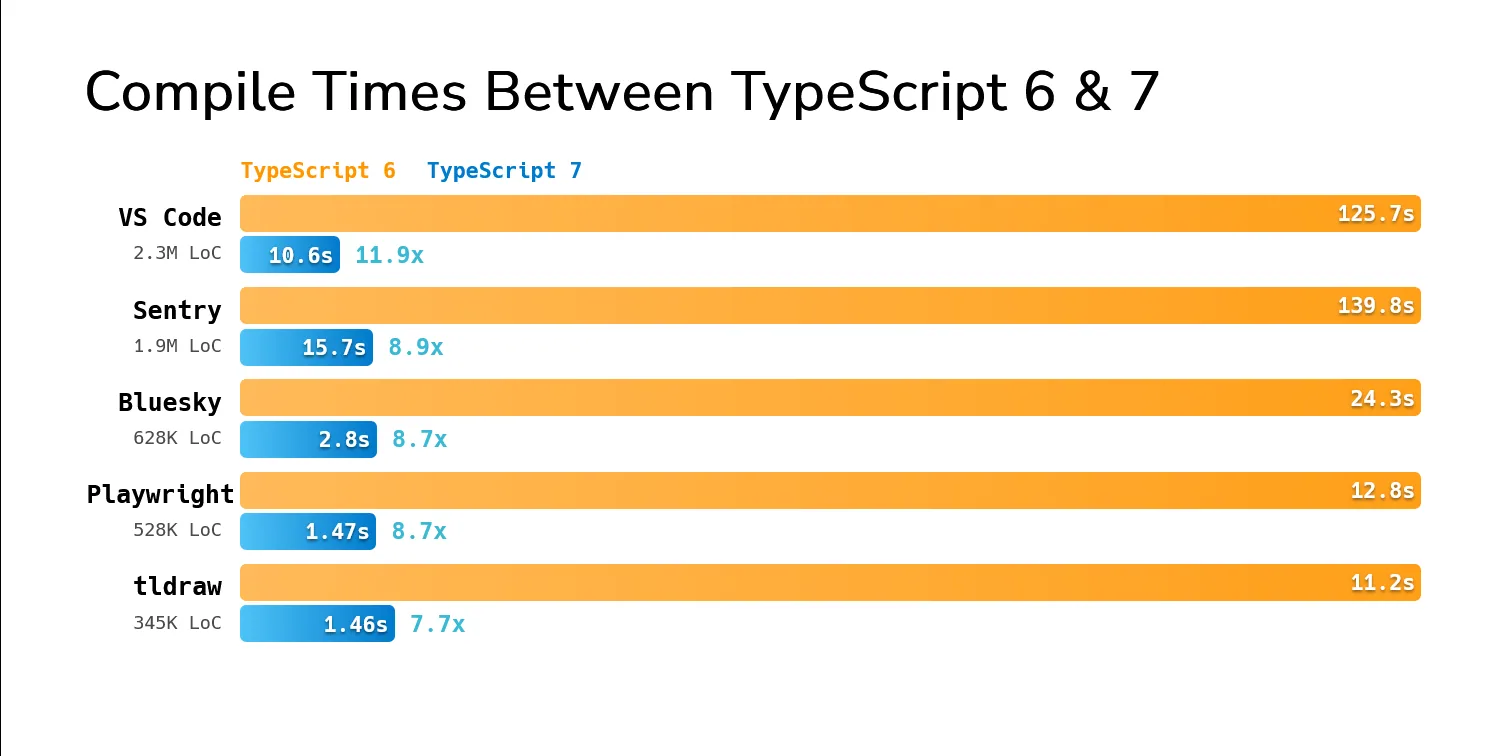
In Microsoft’s launch benchmarks, VS Code drops from 125.7 to 10.6 seconds (11.9×), Sentry from 139.8 to 15.7 seconds (8.9×), Bluesky from 24.3 to 2.8 seconds (8.7×), Playwright from 12.8 to 1.47 seconds (8.7×), and tldraw from 11.2 to 1.46 seconds (7.7×).
The comparison measures compilation of those codebases, with four checker workers in TypeScript 7. These are the TypeScript team’s measurements, not tests conducted by IASolutions. They do not describe total pipeline duration or guarantee the same gains elsewhere. The announcement does not provide a complete methodology for reproducing the results.
A native port, not a new language
According to the official TypeScript 7 announcement, the port closely preserves the structure and logic of the previous compiler. In the full builds published by the team, typical speedups range from 8x to 12x over TypeScript 6. Those figures describe particular tests and codebases; they do not guarantee the same result for every repository, especially when type-checking is only a small part of the overall pipeline.
The advantage does not come from a universal rule that Go makes every compiler faster. What matters is the ability to emit native code, share memory across concurrent work, and revisit internal representations that the old public API made difficult to change. TypeScript 7 parallelizes parsing, emit, and part of type-checking. It uses four checker workers by default, but teams can tune that number: more workers may help large projects while increasing memory use.
The metric that matters is feedback time. A shorter full build helps CI, but an editor that surfaces the first error in seconds rather than after a long pause changes everyday work. A useful evaluation should keep at least three measurements separate: complete checking, incremental checking, and language-server responsiveness during realistic edits.
Memory matters too
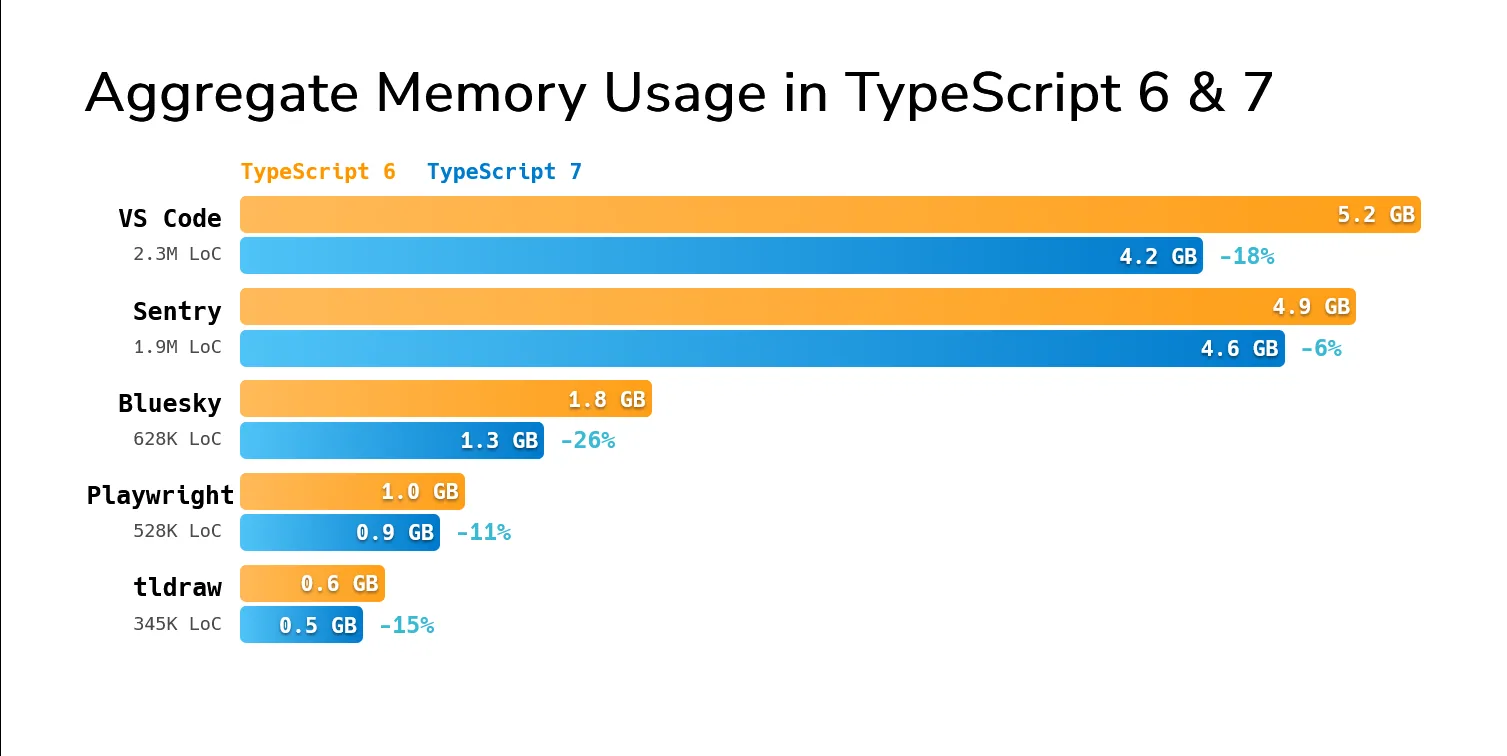
In the same announcement, Microsoft reports lower aggregate memory usage: VS Code drops from 5.2 to 4.2 GB (−18%), Sentry from 4.9 to 4.6 GB (−6%), Bluesky from 1.8 to 1.3 GB (−26%), Playwright from 1.0 to 0.9 GB (−11%), and tldraw from 0.6 to 0.5 GB (−15%). The GB figures are rounded; the percentages are those published by the source.
These figures concern compilation. Sizing a CI runner also requires measuring peak memory on your own project: increasing the number of checker workers can shorten build times while requiring more RAM.
The change reaches the editor
TypeScript 7 replaces the custom TSServer protocol with the Language Server Protocol, the standard that lets different editors reuse the same engine for completion, definitions, references, and diagnostics. This is an architectural move as much as a performance one: it draws a clearer boundary between language intelligence and IDE-specific integration.
Watch mode has also been rebuilt on a cross-platform foundation derived from Parcel’s file watcher. Together with LSP, that moves the benefit from an occasional command into the full development loop. Teams still need to test the editor they actually use. Extensions, auto-imports, rename operations, embedded languages, and plugins may follow paths that a simple `tsc --noEmit` run never exercises.
Migration starts with TypeScript 6
The TypeScript 6 release was designed as a bridge. It enabled `strict` by default, updated module and target behavior, and deprecated the ES5 target, node10 module resolution, and the AMD, UMD, and SystemJS module formats. TypeScript 6 can temporarily ignore several of those settings; TypeScript 7 removes them or turns them into errors. Clearing version 6 warnings before upgrading reduces the number of variables developers must diagnose at once.
When comparing diagnostics and declaration files, TypeScript 6 also provides the stableTypeOrdering flag to align its type ordering with version 7. Treat this as a compatibility check: it can slow down TypeScript 6’s type-checking, so its use must be disclosed in performance comparisons. Keep a separate baseline for the project’s usual configuration.
Also review the defaults for rootDir and types: output paths and global declarations may need explicit tsconfig settings. A successful compilation alone does not establish that every artifact and tool behaves as before.
The temporary fault line: the programmatic API
TypeScript 7.0 does not yet expose a new stable programmatic API. Tools that import the `typescript` package directly cannot treat the native port as a transparent replacement. That affects parts of the linting ecosystem and embedded language services used by Vue, Svelte, Astro, MDX, and Angular. The command-line compiler may be ready while the framework’s complete developer experience is not.
The official native-port repository documents this asymmetry and intentional differences from TypeScript 6. Microsoft supports controlled coexistence: TypeScript 7 for the compiler and, where necessary, the `@typescript/typescript6` compatibility package for tools that still rely on the old API. This is not a configuration to copy blindly, but a temporary strategy to validate against the project’s dependency graph.

A measured adoption path
A safe migration separates compatibility from performance. First establish that the project produces the expected diagnostics and artifacts; only then measure the gain. Timing one command can hide editor regressions, increased runner memory, or incompatibilities in tools that inspect the compiler’s AST.
Move to TypeScript 6 first, make relevant defaults explicit, and resolve every deprecation instead of suppressing it.
Record a baseline for full checking, incremental work, peak memory, and the editor’s time to first diagnostic.
Run TypeScript 7 on a representative pilot project and compare the diagnostic set, not only command duration.
Inventory every consumer of the TypeScript API: linters, generators, transformers, frameworks, language-server plugins, and custom analysis.
Keep the rollout reversible or side by side until editors, CI, and frameworks produce consistent results for the whole team.
Pure TypeScript projects that mainly use the CLI and compatible tools can benefit earlier. Codebases with embedded templates, custom transformers, or deep compiler-API dependencies have stronger reasons to wait or run both versions. In either case, the right decision comes from a toolchain inventory, not repository size alone.
The lesson beyond TypeScript
In the official TypeScript 7.1 plan, opened on July 31, 2026, API stabilization is among the next priorities. This is a roadmap, not evidence that integrations are already available or a guarantee that every framework will be compatible at release. Adoption decisions should follow the versions actually supported by the tools in use.
TypeScript 7 shows that a rewrite can preserve language logic while materially changing the development experience. Speed matters when it shortens a dependable loop: edit, diagnose, verify, and correct. If editor and CI results diverge, the benchmark no longer represents developer productivity.
The final decision can be straightforward: adopt now where the new compiler is already an isolated, measurable component; experiment in parallel where the ecosystem still consumes the previous API; wait where framework compatibility is essential to daily work. Changing the engine only helps when the rest of the vehicle continues to respond as expected.
Key takeaways
- The Go port targets faster feedback through native execution, shared memory, and parallel work.
- Across five Microsoft benchmarks, TypeScript 7 with four checker workers compiles 7.7× to 11.9× faster; these gains are not universal.
- TypeScript 6 is the recommended bridge for clearing deprecations and making configuration explicit.
- The lack of a new stable API in TypeScript 7.0 still limits linters, plugins, and embedded languages.
- A sound migration compares diagnostics, editors, CI, memory, and dependencies—not build time alone.
Frequently asked questions
Does TypeScript 7 change the language syntax?
The main change is the implementation of the compiler and language server. The port aims to preserve TypeScript 6 type-checking logic, while adopting new defaults and removing options that were already deprecated.
Is TypeScript 7 always ten times faster?
No. Across five Microsoft launch benchmarks, using four checker workers, speedups range from 7.7× to 11.9×. These are compilation times: results depend on the project and hardware and do not measure total pipeline duration or application runtime performance.
Why might a project still need TypeScript 6?
TypeScript 7.0 does not yet include a new stable programmatic API. Some tools, plugins, and frameworks import the previous API and may still require TypeScript 6 even when the command-line compiler uses version 7.
How should a team start migrating to TypeScript 7?
Move through TypeScript 6 first, resolve deprecations, record a baseline, and pilot TypeScript 7 on a representative project while checking diagnostics, editor behavior, CI, and API-dependent tools together.