TypeSafe AI’s Jev: what it can really do for your business

In this article
Jev makes structured decisions for software. Explore where it could help your business, how it compares with generative AI and which limitations matter.
Jev is a TypeSafe AI model designed to return structured decisions: choices, scores and probabilities. It can be evaluated for classifying and routing requests in business workflows. It does not generate free-form text and can make mistakes; its value depends on the project’s data, criteria and controls.
A support request arrives: “Our order system freezes whenever I confirm an order. We haven’t been able to dispatch anything this morning.” Before anyone writes a reply, the business needs to decide who should handle it, how urgent it is and what information is missing. This is the less visible work that makes AI useful in everyday operations.
Jev targets that space: bounded judgments that a program can use to move a task forward. For professionals and businesses, understanding its value starts with separating the quality of a decision from the ability to hold a conversation.
This review covers documentation available on September 24, 2026, and Jev 1.13. It compares capabilities and design choices across selected major alternatives. It does not claim to rank market adoption or report an independent benchmark we have not run.
TypeSafe AI and Jev, explained
TypeSafe AI introduced Jev on September 15, 2026, as the first of its “System One Models”, designed for fast, structured decisions. Its launch announcement describes a model architecture, parallel sampling and a training method called Reinforcement Learning for Calibrated Decisions, or RLCD.
Jev is a model that developers integrate into software through an API. The application supplies context and defines the permitted answers. Results feed the application’s logic; the surrounding software executes the actions. “System One” is the company’s name for this approach, rather than a certification of reliability.
It supports three question types:
Choice selects one of the options provided, such as the team that should receive a request.
Score evaluates content against described levels, such as the severity of a reported issue.
Noul returns a probability between zero and one for a yes/no question, such as whether a message reports an operational outage.
A generative language model can compose a new response word by word. Jev works within a predefined decision space. That specialization defines both its usefulness and its boundaries: it is not the model to ask for a sales proposal or a detailed written explanation.
What it could do inside a business
Return to the frozen order system. A possible implementation would give Jev the message, the affected service and a short description of internal categories. It would ask separately about the destination team, reported severity and whether the customer describes a work stoppage. This is a design example, not a test we ran against Jev.
The application could then create a ticket and assign it to a queue. A business rule would determine whether an operational outage requires a manager notification. A generative model could draft a reply for approval. These steps should not be confused with functions Jev performs independently.
Now consider a different message: “I can’t do what I did yesterday. Can you check?” The issue might involve the application, a permission or a changed procedure. Forcing it into a category could produce a tidy but unhelpful result. The design should allow an “insufficient information” outcome and a request for clarification.
The same approach could be evaluated for organizing reports, selecting an available procedure or judging the relevance of retrieved documents. Start with questions whose answers can be checked: which errors are acceptable, who detects them and what happens when the system cannot make a reliable decision?
Where Jev could offer advantages
One potential benefit is a result the application can readily consume: predefined categories and values. Another is evaluating independent questions against the same context in parallel. For a process built from many small judgments, that approach deserves comparison with the tools already in use.
Choice and Score return probability distributions and a confidence value derived from their shape; Noul returns its own probability. Confidence should not automatically be read as the percentage of answers that are correct. It is a signal to validate on business data before using it to separate automatic handling from review.
The official Jev 1.13 specifications list a price of $0.042 per million input tokens, with no charge for output. At an assumed 100 million billable input tokens, model usage alone would therefore cost $4.20. That is an illustrative calculation: integration, data preparation and error handling remain project costs.
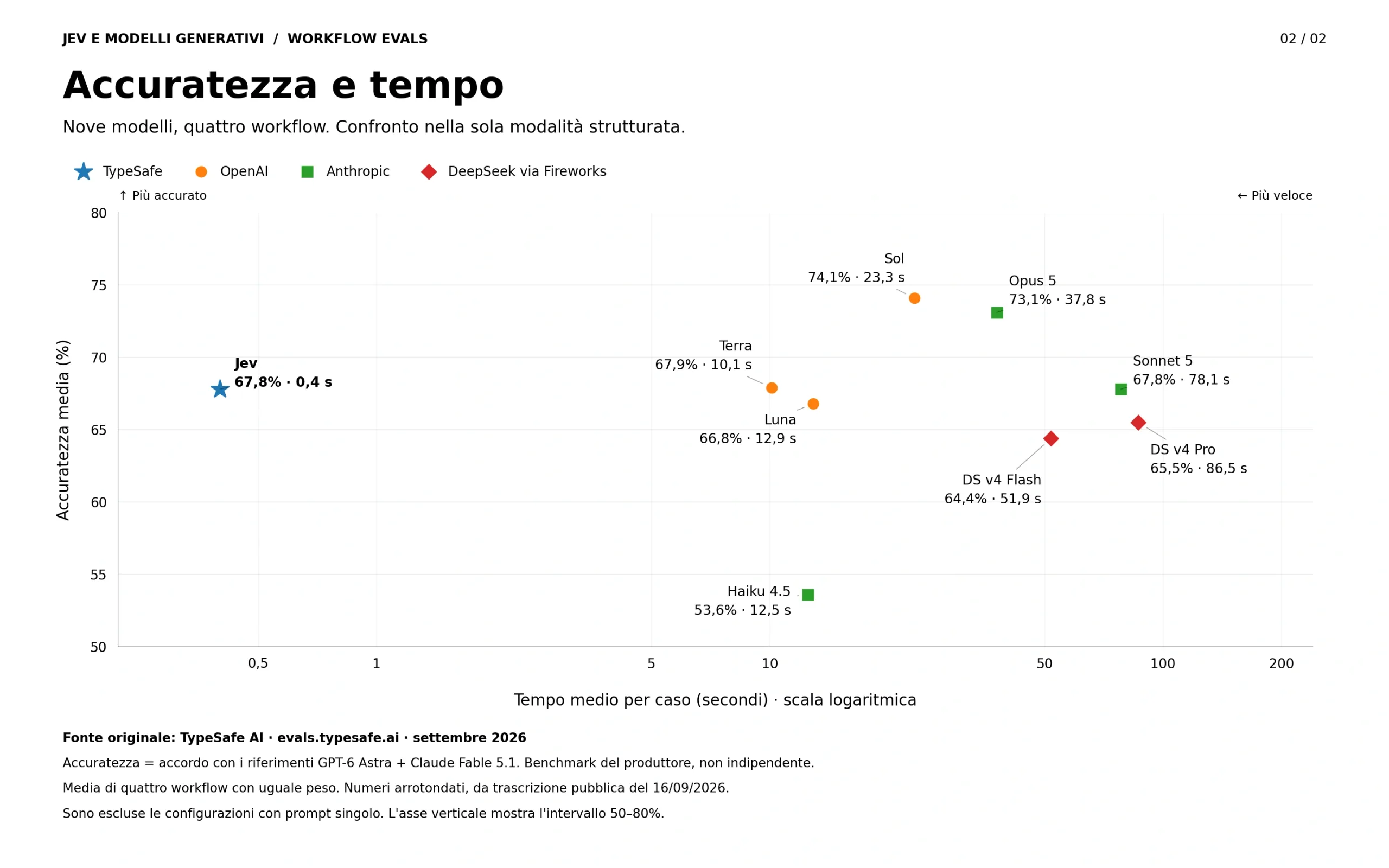
TypeSafe also advertises substantial speed and cost advantages in its comparisons. The launch evaluations cover particular workflows and use other models’ answers as a reference. They provide leads to investigate, not evidence that any business process will achieve the same savings.
Both charts use Italian labels: “accuratezza” means agreement with the reference models, “costo” is USD per case and “tempo” is seconds per case. The horizontal axes use logarithmic scales.
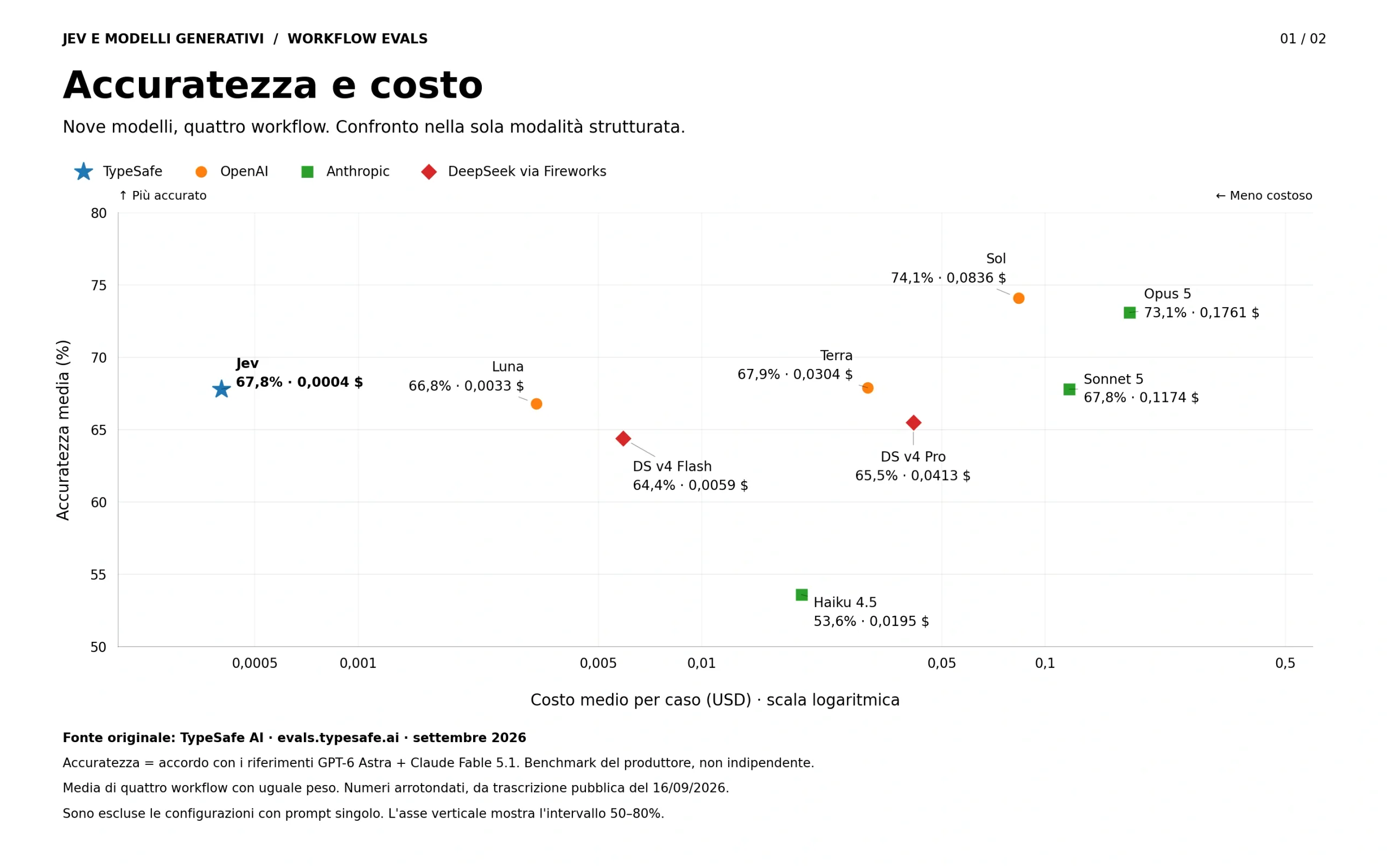
The useful economic measure is the cost of handling a case correctly. An inexpensive API call may be poor value if staff must correct many of its assignments.
Where its limitations matter
The documented limitations of Jev 1.13, reviewed on September 17, 2026, include arithmetic, date comparisons, indirect reasoning and contexts crowded with irrelevant detail. They also describe how adversarial content can influence answers. Jev does not generate free-form text.
The reviewed version accepts text only; images, audio and video require external preprocessing. TypeSafe also identifies English as its strongest language for accuracy. An Italian business should therefore evaluate real messages, abbreviations and industry terminology rather than assume results transfer unchanged.
“Zero hallucinations” does not mean “zero mistakes”
In its launch material, TypeSafe ties the claimed zero rate to schema compliance. An answer can fit the required format perfectly and still be wrong: in the order-system example, “accounts” might be a permitted category but the wrong destination.
A high probability therefore does not replace permissions, checks or approvals. It is useful to distinguish a reversible recommendation, such as suggesting a queue, from an action whose consequences are harder to correct. Choosing those controls is part of the system’s design.
How Jev compares with the alternatives
The comparison here concerns models and APIs, rather than subscriptions to chat applications. Generative models can already return structured values: OpenAI Structured Outputs, for example, can constrain responses to a supported schema. Structured answers still need to be checked for meaning.
For our business scenario, these are the useful distinctions:
GPT can combine text generation with structured responses. It is a candidate when an application needs both to classify a request and draft a reply; Jev should be evaluated on the decision step itself to establish whether it adds value.
Claude offers structured JSON output and strict tool use. Predictable formatting is therefore not exclusive to Jev. An integration must still handle refusals, interrupted responses and documented schema limitations.
Gemini supports structured output in compatible models. Its documentation explicitly distinguishes correct syntax from correct values, a distinction that also matters when assessing Jev.
Grok documents outputs constrained to supported schemas. If a workflow already uses its APIs, introducing Jev should deliver a measurable benefit that justifies another service.
DeepSeek’s documented JSON mode produces valid JSON, with caveats around empty or truncated output. This alone does not guarantee every schema constraint or the correctness of a classification.
Mistral, Qwen and Llama include variants that can run on your own infrastructure using engines such as vLLM. The model, licence, hardware and actual feature support need checking; this offers a different balance between control and operational responsibility.
The vLLM supported-model catalogue documents that last option. Available weights do not remove operating costs: someone must manage capacity, updates and service quality.
Jev’s potential advantage is specialization in repeated decisions. The trade-off is another component to integrate and evaluate, without covering text generation. There is no universal winner: a useful decision requires the same task, the same data and shared success criteria.

When to adopt it, and when to combine it
Our recommendation is to start with a bounded activity whose volume and outcomes can be observed. One example is suggesting a ticket’s destination before an operator confirms it. Comparing the suggestion with the final assignment helps identify where the system works and where it needs correction.
A useful pilot should include:
A representative sample containing clear, ambiguous and out-of-category cases.
Comparison with the existing process, simple rules and at least one relevant AI alternative.
Measures of errors, response time, total cost and the frequency of human review.
Controls over data access and permitted actions, separate from the model’s judgment.
Re-evaluation when the model, instructions or business categories change.
If the main requirement is writing, conversation or an extended explanation, a generative model is needed. If the requirement is repeatedly choosing among defined outcomes, Jev may be worth testing. A process containing both kinds of work may benefit more from combining the tools than replacing one with the other.
The value of AI consulting lies in turning those possibilities into a process that can be assessed: choosing what to automate, measuring errors and deciding when a person should step in.
Want to understand which decisions in your workflow could be automated? Talk to IASolutions about evaluating your data, tools and control criteria.
Key takeaways
- Jev is integrated into software; the application remains responsible for executing actions.
- Correct formatting does not guarantee a correct decision.
- Compare alternatives on the same task using representative business data.
- Total cost includes integration and error correction as well as model usage.
- For workflows that also require writing, consider pairing Jev with a generative model.
Frequently asked questions
Can Jev replace ChatGPT at work?
That depends on the task. Conversation and writing require a generative model. Jev can be evaluated for individual decision steps within an application, such as suggesting a category or destination.
What does “zero hallucinations” mean for Jev?
In its launch material, TypeSafe ties the zero rate to schema compliance. A permitted category can still be the wrong one, so the decision itself needs validation.
How can a business assess whether Jev is worthwhile?
Use a representative sample and compare it with the existing process and relevant alternatives. Measure errors, response time, total cost and review rates against the same success criteria.
Does this article report IASolutions benchmark results?
No. It reviews official documentation consulted on September 24, 2026. The business examples are illustrative, and vendor results are not presented as independent measurements.
Sources
- TypeSafe AI — Introducing System One Models & Jev, September 15, 2026
- TypeSafe AI — Models: Jev 1.13; accessed September 24, 2026
- TypeSafe AI — Jev 1.13 jaggedness, reviewed September 17, 2026
- TypeSafe AI — Confidence; accessed September 24, 2026
- OpenAI — Structured model outputs; accessed September 24, 2026
- Anthropic — Structured outputs; accessed September 24, 2026
- Google — Gemini structured outputs; accessed September 24, 2026
- DeepSeek — JSON Output; accessed September 24, 2026
- xAI — Structured Outputs; accessed September 24, 2026
- vLLM — Supported Models; accessed September 24, 2026